
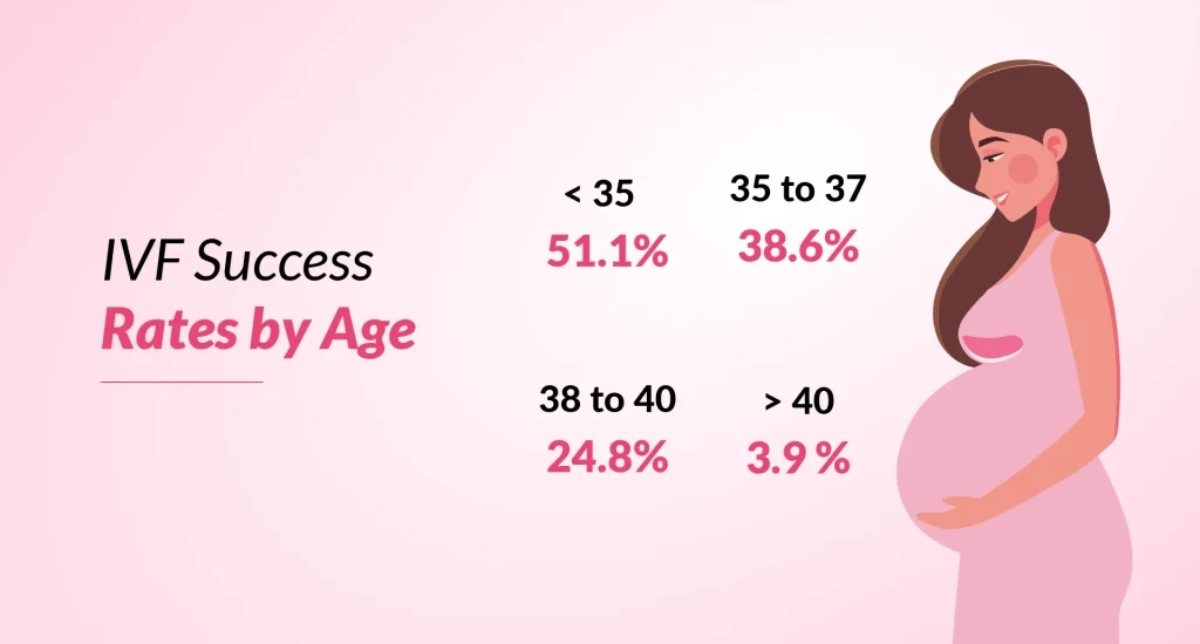
If you are considering IVF, one of the first questions you may have is: What is the IVF success rate by age?
Age is one of the most important factors affecting IVF outcomes, particularly when a woman uses her own eggs. In general, IVF success rates are higher in younger women and gradually decline with increasing age. This is largely related to changes in egg quantity and quality and the increasing likelihood of chromosomal abnormalities in embryos as maternal age increases.
However, age alone cannot predict your individual IVF success rate. Factors such as ovarian reserve, sperm quality, embryo quality, the cause of infertility, previous IVF attempts, the type of treatment used, and whether donor eggs are involved can all affect the likelihood of a live birth.
So, rather than asking only "What is the IVF success rate at my age?", it is more useful to ask: "What is my estimated chance of having a baby based on my age and fertility profile?"
IVF Success Rate by Age: At a Glance
The following CDC data illustrate how live-birth rates after embryo transfer using a patient's own eggs generally decline with age. These are U.S. national ART data from 2022, not a guarantee of an individual's outcome or a specific clinic's success rate.
|
Age |
Live Birth per Embryo Transfer Using Patient's Own Eggs |
|
Under 30 |
43.6% |
|
30 |
43.3% |
|
31 |
43.1% |
|
32 |
43.1% |
|
33 |
42.3% |
|
34 |
41.7% |
|
35 |
40.8% |
|
36 |
39.8% |
|
37 |
38.8% |
|
38 |
36.4% |
|
39 |
34.2% |
|
40 |
31.6% |
|
41 |
28.3% |
|
42 |
24.6% |
|
43 |
20.2% |
|
44 |
15.8% |
|
45 |
13.8% |
|
Over 45 |
10.4% |
Important: These figures represent the percentage of embryo-transfer cycles resulting in a live birth in the CDC's 2022 U.S. data. They are not the same as the chance of live birth per egg retrieval, per IVF cycle started, or cumulative chance after several transfers.
These figures are population-level metrics and do not represent an individual patient's chances of success or failure.
They also should not be used as a personal prediction. Your fertility specialist can provide a more individualized assessment based on your medical and reproductive history.
Why Does IVF Success Decline With Age?
Age affects IVF outcomes primarily through changes in the ovaries and eggs.
As women age:
-
The number of available eggs generally decreases.
-
Egg quality also declines.
-
The likelihood of chromosomal abnormalities in eggs and embryos increases.
-
The risk of miscarriage increases.
-
The probability of producing an embryo capable of leading to a healthy pregnancy decreases.
This is why age is such an important factor when discussing IVF success rates.
The decline does not happen at exactly the same rate for every woman. Two women of the same age can have very different ovarian reserves, embryo quality, and treatment outcomes.
Therefore, an age-based percentage should be viewed as a population average rather than an individual prediction.
IVF Success Rate Under 35
Women under 35 generally have the highest IVF success rates when using their own eggs.
In the CDC's 2022 U.S. data, embryo transfers using the patient's own eggs resulted in a live birth in approximately 43.6% of transfers among women under 30, with rates remaining above 40% through age 34.
However, this does not mean every woman under 35 has a 40%–45% chance with every IVF attempt.
The actual chance can be higher or lower depending on:
-
Ovarian reserve
-
Egg and embryo quality
-
Sperm quality
-
Cause of infertility
-
Number of embryos available
-
Previous IVF history
-
Uterine factors
-
Laboratory and treatment factors
If you are under 35 but have been trying to conceive without success, you do not necessarily need IVF immediately. A fertility evaluation can help determine whether IVF, IUI, medication, surgery, or another approach is appropriate.
IVF Success Rate at 35–37
IVF success rates generally begin to decline gradually during the mid-to-late 30s.
In the CDC's 2022 data, the live-birth rate per embryo transfer using the patient's own eggs was:
-
40.8% at age 35
-
39.8% at age 36
-
38.8% at age 37
These figures demonstrate a gradual decline rather than a sudden drop at age 35.
Being 35 or older does not automatically mean you need IVF. However, age becomes increasingly important when deciding how long to try naturally or with less invasive fertility treatments before moving to IVF.
If you are 35 or older and have been trying to conceive for six months without success, a fertility evaluation is generally recommended rather than waiting a full year. Women over 40 may benefit from more immediate evaluation.
IVF Success Rate at 38–40
By the late 30s and around age 40, the decline becomes more noticeable.
According to the CDC's 2022 data, live birth per embryo transfer using the patient's own eggs was:
-
36.4% at age 38
-
34.2% at age 39
-
31.6% at age 40
This decline is largely related to age-related changes in egg quality and embryo chromosomal health.
If you are approaching or are already in your 40s and are considering pregnancy, speaking with a fertility specialist sooner rather than later can be valuable because treatment options and expected outcomes can change with time.
Jindal IVF provides female infertility treatment and fertility evaluation to help identify factors that may affect your chances of conception.
IVF Success Rate After 40
IVF can still result in pregnancy after 40, but success rates using a woman's own eggs generally become lower.
The CDC's 2022 data show a live-birth rate per embryo transfer using the patient's own eggs of:
-
31.6% at age 40
-
28.3% at age 41
-
24.6% at age 42
-
20.2% at age 43
-
15.8% at age 44
-
13.8% at age 45
-
10.4% above age 45
These figures show that IVF can still result in a live birth at older ages, but the probability generally decreases as age increases.
Importantly, these are population-level figures from one national dataset and should not be interpreted as a guarantee or a personal forecast.
For women over 40, your fertility specialist may discuss whether using your own eggs, donor eggs, or another reproductive option is appropriate based on your ovarian reserve, medical history, treatment goals, and other factors.
Does IVF Success Rate Depend Only on Age?
No.
Age is one of the strongest predictors of IVF outcome, but it is not the only factor.
Your individual IVF chances may also be influenced by:
1. Ovarian Reserve
Ovarian reserve describes the remaining supply of eggs in the ovaries. Tests such as AMH, antral follicle count, and other assessments may be used when appropriate.
However, ovarian reserve tests should not be interpreted as a simple "fertility score." They provide useful information for treatment planning but do not independently determine whether you can become pregnant.
2. Embryo Quality
The quality and developmental potential of an embryo are important factors in implantation and pregnancy.
Embryo quality can be affected by the age of the egg, laboratory factors, and other biological factors.
3. Sperm Quality
Male-factor infertility can contribute significantly to difficulty conceiving.
Semen analysis is an important part of fertility evaluation, and in selected situations, techniques such as ICSI may be considered during IVF.
Jindal IVF provides male infertility treatment as part of its fertility services.
4. Cause of Infertility
IVF outcomes can differ depending on why treatment is being performed.
Possible causes include:
-
Tubal-factor infertility
-
Male-factor infertility
-
Endometriosis
-
Ovulatory disorders
-
Diminished ovarian reserve
-
Unexplained infertility
-
Uterine factors
Understanding the underlying diagnosis is an important part of developing an individualized treatment plan.
5. Previous IVF History
Your previous IVF response can provide useful information when planning future treatment.
For example, your doctor may consider:
-
How many eggs were retrieved
-
How many eggs fertilized
-
Embryo development
-
Number and quality of embryos available
-
Whether implantation occurred
-
Previous pregnancy outcomes
A previous unsuccessful IVF cycle does not automatically mean that another cycle will fail.
IVF Success Rate: Per Cycle vs Per Embryo Transfer
One of the biggest reasons IVF success-rate figures can be confusing is that clinics and organizations may report success using different denominators.
A "success rate" could refer to:
-
IVF cycles started
-
Egg retrievals
-
Embryo transfers
-
Clinical pregnancies
-
Live births
-
Cumulative live birth after one retrieval and multiple embryo transfers
These numbers are not interchangeable.
For example, the chance of live birth per embryo transfer is different from the cumulative chance of having a baby after one egg retrieval followed by all eligible embryo transfers.
The CDC specifically reports different measures, including success per intended retrieval, actual retrieval, and embryo transfer, and also provides cumulative success rates in some datasets.
When comparing IVF clinics, always ask:
"Is this success rate calculated per cycle, per egg retrieval, per embryo transfer, or per patient?"
Also ask whether the reported outcome is clinical pregnancy or live birth, because a pregnancy rate is not the same as the chance of taking home a baby.
What Is a Cumulative IVF Success Rate?
A single IVF cycle may produce more than one embryo.
Instead of transferring all embryos at once, embryos may be frozen and transferred individually in subsequent cycles when clinically appropriate.
This means that looking only at the result of the first transfer may underestimate the overall chance of having a baby from one egg-retrieval cycle.
The CDC's IVF Success Estimator, for example, provides estimates of cumulative live birth after one retrieval and transfers occurring within a specified period.
This is why it is useful to ask your fertility specialist about both:
Live birth per transfer
and
Cumulative live birth after one retrieval and all suitable embryo transfers.
Does IVF Success Rate Improve With Multiple Cycles?
The cumulative chance of having a baby can increase when a patient has additional embryos available for transfer or undergoes additional treatment cycles.
However, this does not mean that every additional IVF cycle guarantees success.
The likelihood of success depends on factors such as:
-
Age at egg retrieval
-
Ovarian response
-
Embryo development
-
Number of embryos available
-
Previous treatment outcomes
-
Underlying infertility diagnosis
-
Whether donor eggs are used
The CDC's IVF estimator allows estimates to be considered across one, two, or three retrievals, illustrating why cumulative outcomes can be different from the result of a single cycle.
Does IVF Success Rate Differ With Donor Eggs?
Yes.
When donor eggs or donor embryos are used, the age of the person providing the eggs is particularly important because egg age is a major determinant of embryo potential.
In the CDC's 2022 data, live-birth rates per embryo transfer using donor eggs or embryos remained much more stable across recipient age groups than rates using the patient's own eggs.
This does not mean donor-egg IVF has the same outcome for every patient. The recipient's health, uterine factors, embryo characteristics, and other considerations still matter.
Can IVF Work After 40?
Yes. IVF can result in a live birth after 40, although success rates using a woman's own eggs generally decline with age.
For some women, IVF using their own eggs may still be a reasonable option after an individualized assessment.
For others, a fertility specialist may discuss donor eggs or other treatment options, particularly when ovarian reserve or embryo development is a significant concern.
The important point is that there is no single age at which IVF becomes impossible. Your fertility specialist should assess your individual circumstances rather than relying on age alone.
How Can You Improve Your IVF Chances?
There is no guaranteed way to make IVF successful, but addressing modifiable health factors and following your fertility specialist's treatment plan can support the best possible outcome.
Depending on your circumstances, this may include:
-
Avoiding smoking and tobacco exposure
-
Maintaining a healthy lifestyle
-
Managing existing medical conditions
-
Taking prescribed prenatal supplements such as folic acid
-
Following medication instructions carefully
-
Attending monitoring appointments
-
Discussing medications and supplements with your fertility specialist
-
Seeking treatment at an experienced fertility centre with an appropriate embryology laboratory
Be cautious of clinics or products promising a guaranteed IVF success rate. No fertility clinic can guarantee a pregnancy or live birth from IVF.
How Does Jindal IVF Chandigarh Approach IVF Treatment?
Jindal IVF Chandigarh provides IVF and other assisted reproductive treatments, with treatment planning based on factors such as age, egg and sperm quality, reproductive history, and underlying fertility conditions.
The clinic states that it has more than 30 years of experience and has conducted more than 15,000 IVF cycles. Its website also explains that IVF success depends on multiple factors rather than age alone.
Jindal IVF offers IVF treatment in Chandigarh, along with IUI, female infertility treatment, male infertility treatment, fertility diagnostics, and genetic services.
If you are considering IVF, a fertility consultation can help you understand your individual chances rather than relying on an age-based average.
When Should You See a Fertility Specialist?
You may benefit from a fertility evaluation if:
-
You have been trying to conceive for 12 months and are under 35
-
You have been trying for six months and are 35 or older
-
You are over 40 and want to become pregnant
-
You have irregular or absent periods
-
You have known or suspected endometriosis
-
You have blocked or damaged fallopian tubes
-
You have a known or suspected male fertility problem
-
You have experienced recurrent pregnancy loss
-
You have had previous fertility treatment without success
-
You have a condition or treatment history that may affect fertility
Earlier evaluation may be appropriate when there is a known or suspected fertility problem.
Frequently Asked Questions
What is the IVF success rate by age?
IVF success generally declines as age increases when a woman uses her own eggs. In CDC's 2022 U.S. data, live birth per embryo transfer using the patient's own eggs was 43.6% for women under 30, 40.8% at age 35, 31.6% at age 40, and 13.8% at age 45. These are population-level figures and do not predict an individual's outcome.
What is the IVF success rate under 35?
In the CDC's 2022 U.S. data, the live-birth rate per embryo transfer using the patient's own eggs was 43.6% for women under 30 and remained above 40% through age 34. However, your individual chance can be different depending on ovarian reserve, embryo quality, sperm factors, diagnosis, and other circumstances.
What is the IVF success rate at age 40?
In the CDC's 2022 data, 31.6% of embryo transfers using the patient's own eggs resulted in a live birth among women aged 40. This is a population average and should not be interpreted as an individual prediction.
Can IVF work at age 45?
Yes, IVF can result in a live birth at 45 and beyond, although success rates using one's own eggs are generally lower than at younger ages. In the CDC's 2022 data, the live-birth rate per embryo transfer using the patient's own eggs was 13.8% at age 45 and 10.4% above age 45.
Does IVF guarantee pregnancy?
No. IVF improves the chances of pregnancy for many people with infertility, but it does not guarantee pregnancy or a live birth. Outcomes vary according to age, egg and sperm factors, embryo characteristics, diagnosis, treatment history, and other factors.
Is IVF more successful with younger eggs?
Generally, yes. Egg age is an important determinant of embryo potential and IVF outcomes. This is one reason IVF success rates using a woman's own eggs generally decline with increasing age.
Are IVF success rates higher with donor eggs?
Donor-egg IVF can have different success patterns because the age of the egg provider, rather than the recipient's age, is a major factor in egg and embryo potential. CDC data show that live-birth rates per embryo transfer using donor eggs or embryos are substantially more stable across recipient age groups than rates using the patient's own eggs.
How many IVF cycles should I try?
There is no universal number of IVF cycles that is right for everyone. Your fertility specialist may consider your age, ovarian response, embryo development, previous outcomes, diagnosis, and treatment goals when deciding whether another cycle is appropriate.
What is the best age for IVF?
There is no single "best age" that applies to everyone, but IVF using a woman's own eggs generally has higher success rates at younger ages. Fertility declines with age, so people who are concerned about fertility should consider timely evaluation rather than waiting for a specific age.
How can I find out my personal IVF success rate?
An age-based table can only provide a general estimate. A fertility specialist can assess factors such as age, ovarian reserve, sperm parameters, infertility diagnosis, previous treatment, and embryo-related factors to provide a more individualized assessment.
Jindal IVF can evaluate these factors as part of its fertility and IVF services.