
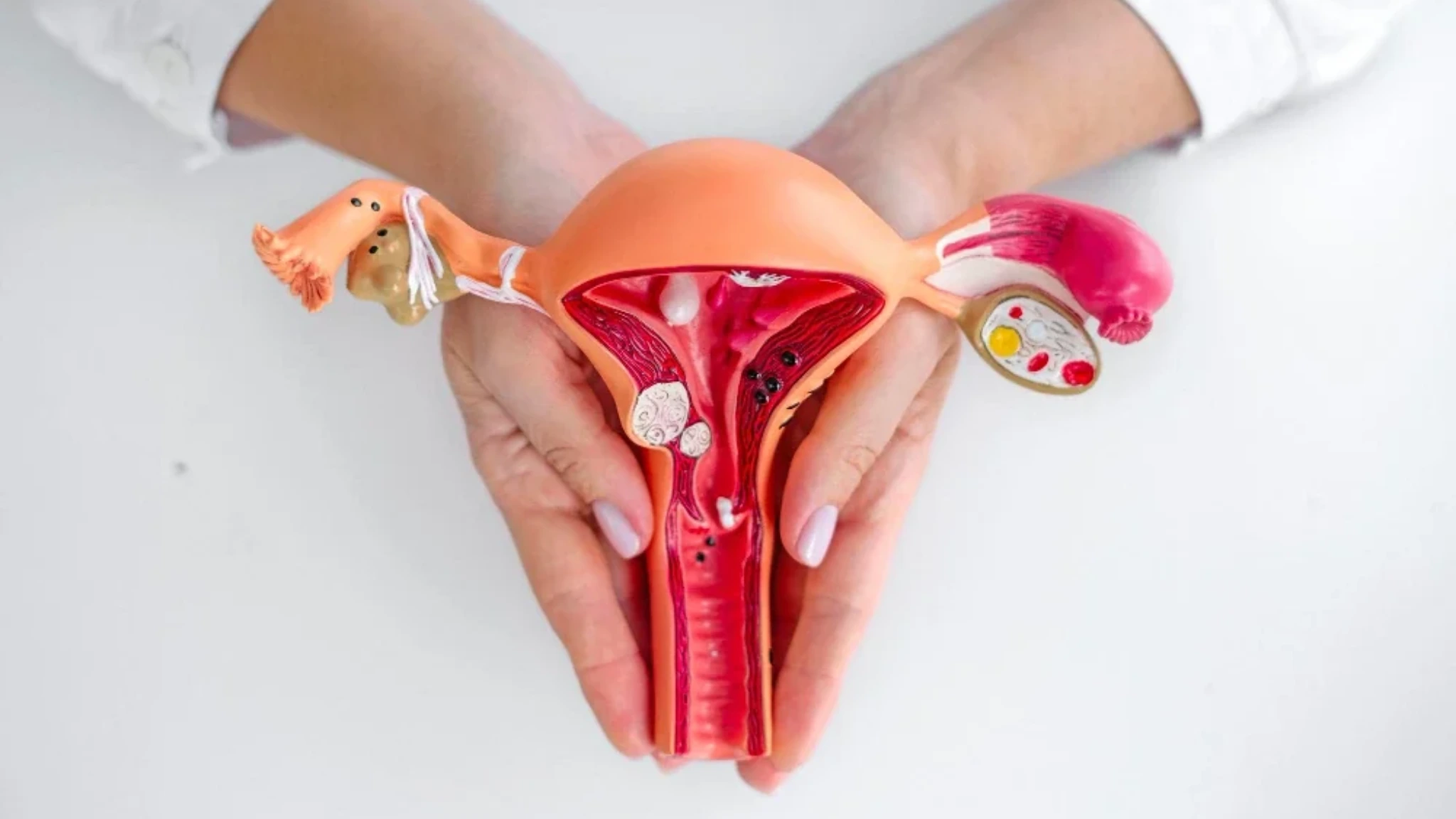
You get your ultrasound report, see two sets of measurements for the right and left ovary, and start to wonder whether they are "big enough" to get pregnant.
There is no size you need. No minimum guarantees a problem and no normal range guarantees a pregnancy. Ovary size is a small piece of context on a scan. Whether you ovulate, your age, and the health of your tubes and your partner's sperm tell a doctor far more.
What is a normal ovary size?
In women who are still having periods, a typical ovary measures roughly 2.5 to 5 cm in length and 1.5 to 3 cm in width, and it is thinner than it is wide. Doctors usually care less about the three separate numbers than about the volume they produce.
The usual formula is length × width × thickness × 0.52. For an ovary of 3.5 × 2.2 × 1.8 cm, that works out to about 7 mL. Healthy ovaries in this age group average around 6 mL, and a volume under about 10 mL is generally considered within normal limits. Many sonographers calculate this for you and print it on the report.
The measurements change from scan to scan. A growing follicle, a corpus luteum after ovulation, a simple cyst, or fertility medicine can all make an ovary look bigger for a few days or weeks. That is why the same ovary can measure differently in two cycles.
Does ovary size affect your chances of getting pregnant?
Not in a way you can predict from the number. A woman with smaller or larger ovaries than average can conceive without difficulty if she ovulates regularly and the other pieces are in place. Equally, ovaries of textbook size do not rule out infertility.
Size is a clue at most:
- Very small ovaries can sometimes go with a low egg supply, particularly in older women or after ovarian surgery.
- Large ovaries are often explained by a cyst, a dominant follicle, PCOS, endometriosis or treatment medicines.
In each case the doctor looks inside the ovary, not just at its outline.
Ovary size, follicle size and ovarian reserve are three different things
These are the terms that cause the most confusion on reports.
- Ovary size is the physical dimensions or volume of the organ.
- Follicle size is the measurement of a single fluid-filled sac inside the ovary that holds an egg. When your cycle is being monitored for ovulation, the dominant follicle is often around 18 to 24 mm just before it releases the egg. That number is not comparable to the ovary's size.
- Ovarian reserve is the egg supply you have left. Doctors estimate it from your age, an AMH blood test, and an antral follicle count on ultrasound.
A bigger ovary does not mean more eggs, and a smaller one does not mean fewer. Volume is a weak stand-in for reserve, which is why clinics rely on AMH and the follicle count instead.
The tests that tell you more
|
Test |
What it shows |
What it is good for |
|---|---|---|
|
Age |
Strongly linked to egg quantity and quality |
The single most important fertility factor |
|
Ovulation tracking |
Whether an egg is released each cycle |
Judging chances of natural conception |
|
Antral follicle count (AFC) |
Number of small follicles seen on ultrasound, ideally early in the cycle |
Estimating reserve and likely response to treatment |
|
AMH blood test |
Hormone made by small follicles |
Estimating reserve, planning IVF doses |
|
Ovary volume |
Size of the organ |
Added context, such as spotting a cyst or PCOS pattern |
One caution on AMH and AFC: they estimate how many eggs you have and how you may respond to treatment. They do not tell you whether you can conceive naturally. Women with low AMH do get pregnant, and women with high AMH can struggle for other reasons.
None of these measures egg quality. Age remains the best guide to that, because the share of eggs with chromosome errors rises as we get older.
Do both ovaries need to match?
No. Small differences between the right and left ovary are common, partly because only one side usually ovulates in a given cycle. Neither side is better for pregnancy, and ovulation can come from either one.
It is worth asking your doctor about a difference that is large or that shows up on repeat scans, especially if one ovary has a cyst or an unusual look inside.
Can you get pregnant with one ovary, or one small ovary?
Yes. If the remaining ovary releases an egg and at least one fallopian tube is working, natural pregnancy is possible. Many women conceive after having an ovary removed for a cyst, torsion or endometriosis.
With a small ovary, a doctor will look at your cycles, AMH, follicle count, age and tubes before drawing any conclusion. The size on its own does not decide anything.
What about PCOS and large ovaries?
PCOS often comes with bigger ovaries and many small follicles, but a large ovary does not mean you have PCOS. Cysts, a corpus luteum and endometriomas can all do the same thing.
Under the 2023 international guideline, PCOS is diagnosed when two of three features are present: irregular or absent ovulation, signs or blood tests of high androgens, and polycystic-looking ovaries. On ultrasound that last feature means at least 20 follicles measuring 2 to 9 mm in one ovary, or an ovarian volume of 10 mL or more, in a scan free of cysts and a dominant follicle. In adults, an AMH blood test can be used instead of the ultrasound for that third feature. (source, Radiopaedia summary)
A scan alone is therefore not a diagnosis, and you should not self-diagnose from the report.
Many women with PCOS get pregnant naturally or with treatment. The main hurdle is usually irregular ovulation rather than the size of the ovaries.
Does ovary size matter in IVF?
Rarely. IVF teams plan around age, AMH, follicle count, and how you responded to medicine before. During stimulation the ovaries swell, sometimes a lot, because many follicles grow at once. That is expected and monitored with scans. Severe bloating, pain, vomiting or breathlessness during treatment should be reported to the clinic the same day.
Can food, supplements or exercise make your ovaries bigger?
No. There is no proven way to enlarge your ovaries or rebuild your egg supply, and products that claim to do so should be treated with suspicion. Healthy habits, such as not smoking, staying active and managing weight and blood sugar, support overall fertility and help ovulation in conditions like PCOS, but they do not change your reserve.
When to see a fertility specialist
Talk to a doctor if you have not conceived after:
- 12 months of regular unprotected sex, if you are under 35
- 6 months, if you are 35 or older
Do not wait that long if you are over 40, or if you have any of these:
- Very irregular or missing periods
- PCOS or endometriosis
- Previous ovarian or pelvic surgery, chemotherapy or pelvic radiation
- A family history of early menopause
- Known tubal problems or a partner with known sperm problems
Also ask about any scan that shows a complex cyst, a very large ovary, or two ovaries that look very different.
Get urgent care for sudden severe pelvic pain, especially with vomiting, fever, dizziness or fainting. An ovarian cyst can twist or rupture, and that needs treatment quickly.
Frequently asked questions
Is a 2 cm ovary normal? A length of 2 cm is a little under the usual range, but it can be normal, particularly if the other dimensions and the volume are fine. A single number is not interpreted alone.
Is a 3 cm or 4 cm ovary normal? Both are common in women of reproductive age. A 4 cm length may simply reflect a follicle that is growing. The volume and what is inside the ovary matter more.
Can small ovaries produce eggs? Yes. Size does not decide whether an ovary ovulates. Cycle pattern, AFC and AMH are better guides.
Which ovary is better for pregnancy, right or left? Neither. Ovulation can come from either side.
Does a big ovary mean PCOS? No. PCOS needs a broader assessment of cycles, hormones and the scan.
Does ovary size tell me about egg quality? No. Age is the best indicator of egg quality.
Does a low AMH mean I can't get pregnant? No. A low AMH suggests a lower egg supply, but many women with low AMH conceive. It matters most for planning treatment and for deciding how soon to act.
The takeaway
If your report shows ovaries that are a bit larger, smaller or uneven, you are probably worrying about the wrong number. Ask your doctor about three things instead: whether you are ovulating, what your AFC and AMH show for your age, and whether your tubes and your partner's semen have been checked.
Book a fertility consultation: Jindal IVF, SCO 21, Sector 20 D, Old Cloth Market, Dakshin Marg, Chandigarh 160020. Call +91-9582499479 or make an appointment online.


