
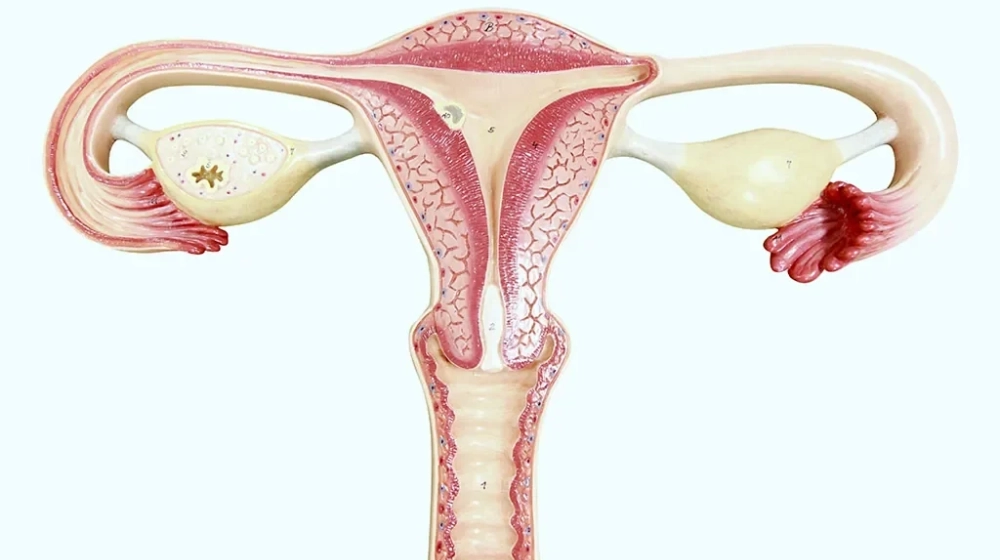
Before pregnancy, the uterus is about the size of a pear and weighs roughly 60 to 70 grams. By the end of pregnancy it weighs around a kilogram. Six weeks after delivery it has shrunk back. Hardly any other organ changes this much, and none repeats the cycle every single month.
So what is the uterus, and what is it doing when you are not pregnant? In short, it prepares for a pregnancy that may or may not come. Everything else about the functions of the uterus follows from that.
What is the uterus?
The uterus, or womb, is a hollow muscular organ in the lower pelvis, between the bladder in front and the rectum behind. It is shaped like an upside-down pear, about 7 to 8 cm long in a woman who has not been pregnant. The fallopian tubes enter it at the top, and the cervix at the bottom opens into the vagina.
Its wall has three layers: a thin outer covering (perimetrium), a thick muscle layer (myometrium) that stretches in pregnancy and contracts in labour, and an inner lining (endometrium) that is rebuilt every month.
A month in the life of the uterus
The main function of the uterus in a non-pregnant woman is the monthly cycle.
-
Days 1 to 5: shedding. If there was no pregnancy last cycle, the old lining leaves the body as your period. A normal period lasts up to 7 days with average blood loss of about 30 to 40 ml. More than 80 ml in a cycle counts as heavy bleeding.
-
Days 6 to 14: rebuilding. Oestrogen from the ovary makes the lining grow thick and rich in blood vessels again.
-
Around ovulation: waiting. The uterus is ready, and an egg is released from the ovary into the tube.
-
Days 15 to 28: preparing. Progesterone makes the lining soft and nutrient-rich. This is the "implantation window", when an embryo can attach if there is one.
If no embryo arrives, hormone levels drop and the cycle starts over. Our article on menstrual cycle and hygiene goes deeper into this.
Nine months: the pregnancy uterus
If an embryo does arrive, the uterus takes on its most demanding functions.
-
Implantation. About 6 to 10 days after ovulation the embryo attaches to the lining. Many clinics look for a lining of about 7 to 8 mm or more at this point. A thin lining is a common reason for failed implantation; see thin uterine lining.
-
Feeding and protecting the baby. The placenta forms in the uterine wall and passes oxygen and nutrients to the baby while carrying waste away.
-
Growing with the baby. A pregnancy uterus rises out of the pelvis at around 12 weeks, reaches the navel at about 20 weeks and the lower ribs by about 36 weeks. Week-by-week details are in our first trimester, second trimester and third trimester guides.
-
Labour. Near term, the muscle wall contracts under the influence of oxytocin, opens the cervix and pushes the baby out.
-
Recovery. After birth the uterus keeps contracting to deliver the placenta and limit bleeding, then returns close to its original size over about six weeks.
When the uterus is the reason you are not conceiving
You can have healthy ovaries, open tubes and good sperm and still not get pregnant if the uterus cannot hold an embryo. Uterine problems usually cause repeated implantation failure or early miscarriage, not missed periods, so they are easy to overlook. They fall into four groups.
Growths. Fibroids (non-cancerous muscle growths) and endometrial polyps can distort the cavity. Signs include heavy periods or spotting between periods, though some women have none.
Shape. A uterine septum, a band of tissue dividing the cavity, is present from birth and is linked with repeated miscarriage. A tilted (retroverted) uterus, found in about one woman in five, is usually harmless and often straightens as the uterus grows in early pregnancy.
Scarring. Intrauterine adhesions (Asherman's syndrome) can follow infection or procedures such as D&C and typically cause very light or absent periods. Genital tuberculosis can scar the lining too, often without symptoms; read about female genital tuberculosis.
Lining and wall. A persistently thin endometrium, or adenomyosis (lining tissue growing into the muscle wall, causing painful heavy periods), can both reduce the chance of implantation.
At Jindal IVF Chandigarh, the uterus is checked as part of every infertility work-up. A pelvic ultrasound comes first, and if something looks unclear we move to saline sonography, HSG or hysteroscopy, where a thin camera looks inside the cavity. Polyps, adhesions and a septum can often be treated during the same hysteroscopy. You can read about hysteroscopy in fertility treatment, or about our endoscopy services.
Signs worth getting checked
A uterus that is working well usually gives predictable cycles, cramps you can manage and no lasting pelvic pain. See a gynaecologist if you notice:
-
cycles shorter than 21 or longer than 35 days
-
bleeding for more than 7 days, or soaking a pad every hour or two
-
bleeding between periods, after sex or after menopause
-
period pain that does not settle with medicine
-
no pregnancy after 12 months of trying (6 months if you are 35 or above)
If your periods are regular and you still cannot conceive, regular periods do not prove the uterus is fine. Read regular periods but not getting pregnant.
Quick answers
What is uterus size normally?
About 7 to 8 cm long, 4 to 5 cm wide and 2.5 to 3 cm thick in a woman who has not had a baby. It is slightly larger after childbirth.
What is the main function of the uterus?
To carry a pregnancy. When there is no pregnancy it produces the monthly period, and in labour it contracts to deliver the baby.
Can you get pregnant without a uterus?
No, a woman without a uterus cannot carry a pregnancy. If her ovaries work, she may still have a genetic child through IVF with a gestational carrier, within the rules of the Surrogacy (Regulation) Act, 2021. See our guide to surrogacy in India.
Does a tilted uterus affect pregnancy?
Usually not. It rarely affects fertility and often corrects itself in early pregnancy.
Start with a scan
If your periods are off, a scan report mentions something you do not understand, or pregnancy is taking longer than expected, a pelvic ultrasound is the simplest first step. You can book a consultation with the team at Jindal IVF Chandigarh, or call +91-9582499479. If a procedure turns out to be needed, our IVF treatment in Chandigarh and gynaecology teams work together under one roof.